
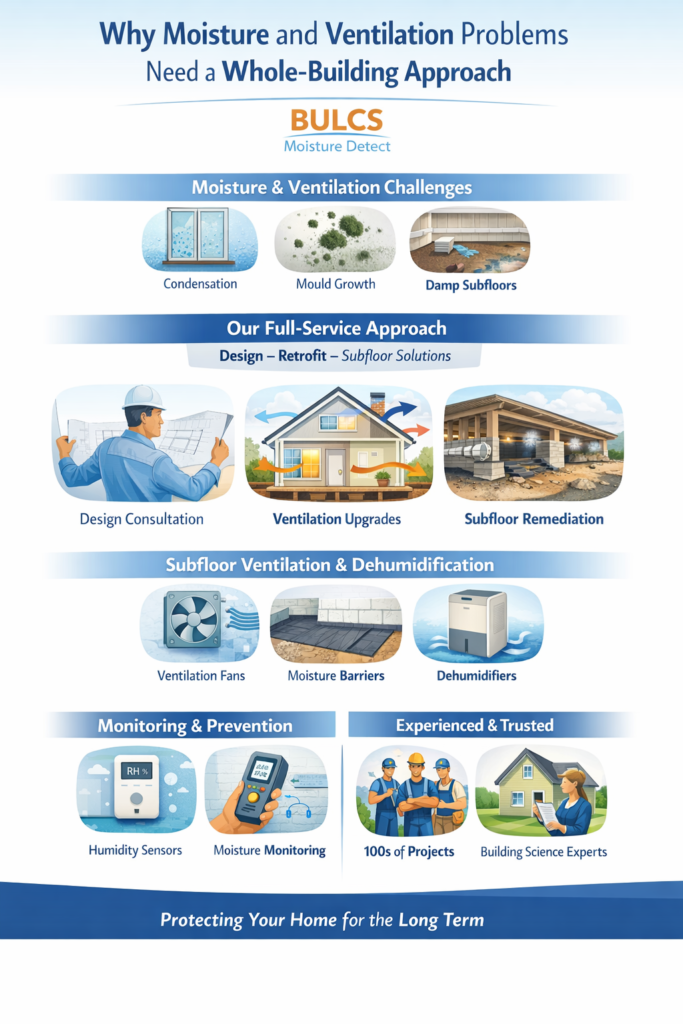
Mould on walls. Damp subfloors. Condensation on windows. Musty odours that won’t go away. These are the complaints we hear most often and in almost every case, they share one underlying cause: the building is not managing moisture effectively.
Too often, these symptoms are treated in isolation. A dehumidifier here. A bathroom exhaust fan there. A coat of mould-resistant paint. These interventions may reduce visible symptoms temporarily, but without addressing the root cause, the problem returns – usually worse.
Solving moisture problems properly requires understanding the building as an integrated system.
Moisture Doesn’t Behave in Isolation
Air, heat, and moisture are in constant movement throughout a building. They migrate through walls, floors, ceiling cavities, and subfloor spaces driven by pressure differentials, temperature gradients, and vapour pressure.
When that movement is obstructed, unmanaged, or imbalanced, moisture accumulates. It deposits in materials, cavities, and surfaces. Given sufficient time and humidity, the consequences are predictable:
- Mould growth in wall cavities, subfloors, and living spaces
- Timber decay and structural degradation
- Flooring failure (cupping, swelling, delamination)
- Elevated indoor humidity affecting occupant health and comfort
- Deteriorating building envelope performance
The three primary drivers behind these outcomes are inadequate ventilation, moisture intrusion from the building envelope or ground plane, and excessive internal moisture loads from occupants, cooking, and bathrooms. In most real-world cases, two or more of these factors are present simultaneously.
What a Whole-Building Approach Actually Means
A whole-building approach means that before any solution is specified, we first establish a clear picture of how moisture is entering the building, where it is accumulating, and why existing ventilation is failing to manage it.
This involves:
- Moisture diagnostics – measuring timber moisture content, relative humidity conditions, and surface dewpoint temperatures across multiple building zones.
- Ventilation assessment – evaluating existing exhaust and supply systems for capacity, location, and actual performance versus design intent.
- Building envelope review – identifying pathways for moisture intrusion including subfloor vapour migration, wall penetrations, and roof or window interface failures.
- Occupancy and load profiling – understanding how internal moisture generation from occupants and building use is contributing to overall humidity loads.
Only once this picture is complete can an effective, durable solution be designed.
Design Stage: Prevention Is Far Cheaper Than Remediation
For new construction, the most cost-effective time to address moisture and ventilation performance is during the design phase – before a single material is installed.
We work with architects, builders, and developers to review:
- Ventilation system design – ensuring mechanical systems are sized, positioned, and specified to meet actual performance requirements, not just minimum compliance thresholds.
- Subfloor ventilation planning – designing airflow paths that prevent ground moisture from migrating into the building structure.
- Vapour management strategies – specifying appropriate barriers, membranes, and material selections for the specific climate zone and exposure conditions.
- Condensation risk modelling – identifying wall and roof assemblies that may be vulnerable to interstitial condensation under local temperature and humidity conditions.
A thorough design-stage review typically costs a fraction of one moisture remediation project. The return on investment is unambiguous.
Retrofit Solutions: Fixing What Wasn’t Built Right
A significant proportion of Australia’s existing housing stock was constructed before modern ventilation standards, condensation management requirements, or subfloor moisture guidelines were established. Many of these buildings now exhibit chronic moisture problems that will not resolve without deliberate intervention.
Common scenarios we address:
- Condensation and mould in apartments and townhouses – typically driven by inadequate mechanical exhaust, thermal bridging, and insufficient fresh air supply in tightly sealed envelopes.
- Subfloor moisture and timber decay– ground moisture migrating into underfloor timber framing and flooring systems, often accelerated by inadequate or blocked subfloor ventilation.
- Persistent indoor humidity in older homes – buildings relying entirely on infiltration for ventilation that have been progressively sealed through renovation, reducing natural air exchange below sustainable levels.
- Post-remediation recurrence – buildings where mould or moisture damage has been treated without addressing the underlying ventilation or moisture pathway deficiency.
In each case, the solution is designed around the specific building, site conditions, and failure mechanism not a generic specification pulled from a product catalogue.
Subfloor Moisture: An Underestimated Risk
Subfloor environments represent one of the highest-risk moisture zones in Australian residential construction, yet they remain largely invisible to building owners until damage has already progressed significantly.
Ground moisture migrates upward through vapour transmission and, in poorly sealed subfloor spaces, can maintain chronically elevated relative humidity conditions – often exceeding 80–90% RH. At these levels, timber moisture content rises, and the conditions for fungal growth and timber decay become established.
Effective subfloor remediation typically requires a combination of:
- Subfloor ventilation systems – mechanically driven or passive, designed to create consistent cross-ventilation and humidity reduction across the entire underfloor zone.
- Ground vapour barriers – correctly specified and installed membranes that interrupt the vapour transmission pathway from soil to structure.
- Dehumidification – in confined or complex subfloor geometries where ventilation alone cannot maintain safe humidity levels.
- Moisture monitoring – embedded sensors that provide ongoing visibility of subfloor conditions post-installation.
Each installation is designed to suit the specific site geometry, soil conditions, and building construction type. There is no universal solution.
Continuous Monitoring: From Reactive to Proactive
One of the most significant advances in building moisture management over the past decade has been the accessibility of continuous monitoring technology.
By embedding sensors within structural elements, subfloor spaces, and wall cavities, building owners and managers can now track timber moisture content over time, relative humidity conditions across multiple building zones simultaneously, and environmental anomalies such as sudden moisture events, seasonal shifts, or equipment failures that would otherwise go undetected.
This moves moisture management from a reactive, damage-response model to a proactive, risk-management model. For commercial buildings, heritage structures, and high-value residential properties, continuous monitoring represents a meaningful reduction in long-term maintenance risk and cost.
Why Getting the Diagnosis Right Matters
Moisture problems are not always what they appear to be. Surface mould on a bathroom ceiling may indicate inadequate exhaust ventilation or it may indicate a roof leak, a cold thermal bridge, or a combination of all three. Misdiagnosis leads to solutions that fail, costs that compound, and damage that continues.
Our approach is grounded in building science principles and informed by extensive field experience across residential, commercial, and heritage building types. We use diagnostic data to drive solution design, and we specify interventions that address root causes- not surface symptoms.
Protecting Buildings for the Long Term
Moisture is the single largest driver of premature building deterioration in Australia. It degrades structural materials, compromises indoor air quality, reduces thermal performance, and creates significant liability for building owners and managers.
Addressing moisture and ventilation properly whether at the design stage or through targeted remediation is an investment in the long-term durability and performance of the building asset.
At BULCS / Moisture Detect, our work is built on one core principle: identify the actual cause, design the right solution, and deliver an outcome that lasts.
Speak With Our Team
Whether you are dealing with an active moisture or mould problem, planning a new build, or looking to establish a monitoring programme for an existing property we can help.
BULCS / Moisture Detect provides investigation, design, and installation services across residential, commercial, and heritage building projects.
Contact us to discuss your project 1300 654 684 or email sale@bulcsholdings.com.au